Development of PROTAC-Based Protein Degraders
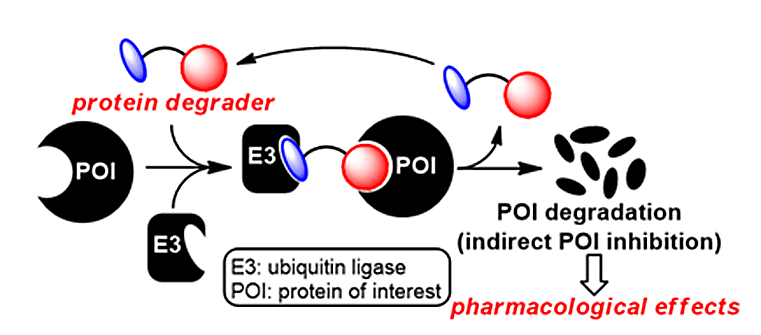
Proteolysis-targeting chimeras, known as PROTACs, are molecules that induce the selective degradation of target proteins by recruiting the cell’s protein degradation machinery. They have attracted growing interest as a new modality in drug discovery. PROTACs differ from conventional drug molecules, such as enzyme inhibitors and receptor antagonists, in their mode of action. Conventional drug molecules generally suppress specific functions of target proteins. In contrast, PROTACs reduce the abundance of target proteins through degradation and can therefore suppress multiple functions of the target protein, including functions that are difficult to block with conventional inhibitors. We are interested in these unique properties and have conducted drug-discovery-oriented research on PROTACs that target proteins with both enzymatic functions and scaffold functions. These proteins not only catalyze biochemical reactions in cells but also interact with other proteins to regulate biological processes. In this research program, we have identified PROTACs targeting proteins such as histone deacetylases (HDACs) and have demonstrated the advantages of PROTACs over conventional inhibitors.
Related Publications
- Journal of Medicinal Chemistry, 68, 18258–18271, 2025.
- Chemical Communications, 68, 4635–4638, 2022.
- ChemMedChem 16, 1609-1618, 2021.
- Journal of the American Chemical Society, 132, 5820-5826, 2010.
Drug Discovery Based on Enzyme Inhibition Kinetics
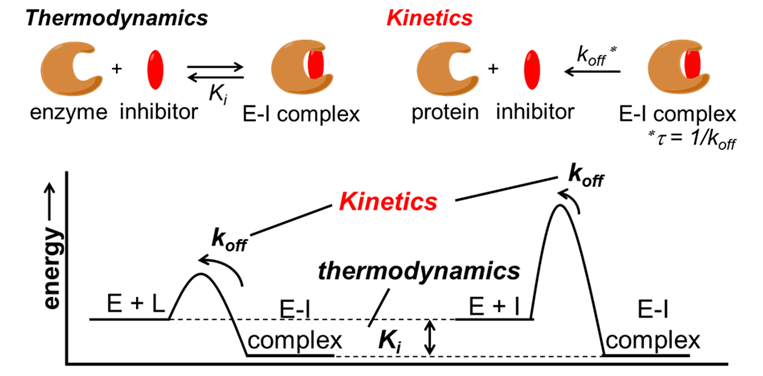
As in organic chemical reactions, the formation of an inhibitor–enzyme complex has both thermodynamic and kinetic aspects. In the development of enzyme inhibitors, compound activity is commonly evaluated using thermodynamic parameters such as the inhibition constant Ki or the half-maximal inhibitory concentration IC50. However, in cellular and in vivo systems, pharmacological effects do not always correlate well with Ki or IC50 values. This is because these systems contain many factors and involve dynamic biological events that can affect drug action.In contrast, kinetic parameters provide another useful perspective, although they are often less emphasized in conventional inhibitor development. In particular, the dissociation rate constant koff of the inhibitor–enzyme complex, and its reciprocal, the residence time τ (τ = 1/koff), have been reported to be less affected by assay conditions and biological systems. These parameters can therefore provide useful estimates of the strength and duration of inhibitor–enzyme interactions in cellular and in vivo settings. Based on this concept, we believe that enzyme inhibitor development should consider not only thermodynamic properties but also kinetic properties. Our research aims to create enzyme inhibitors by integrating enzyme inhibition kinetics into drug discovery.
Related Publications
Click Chemistry-Based Drug Discovery
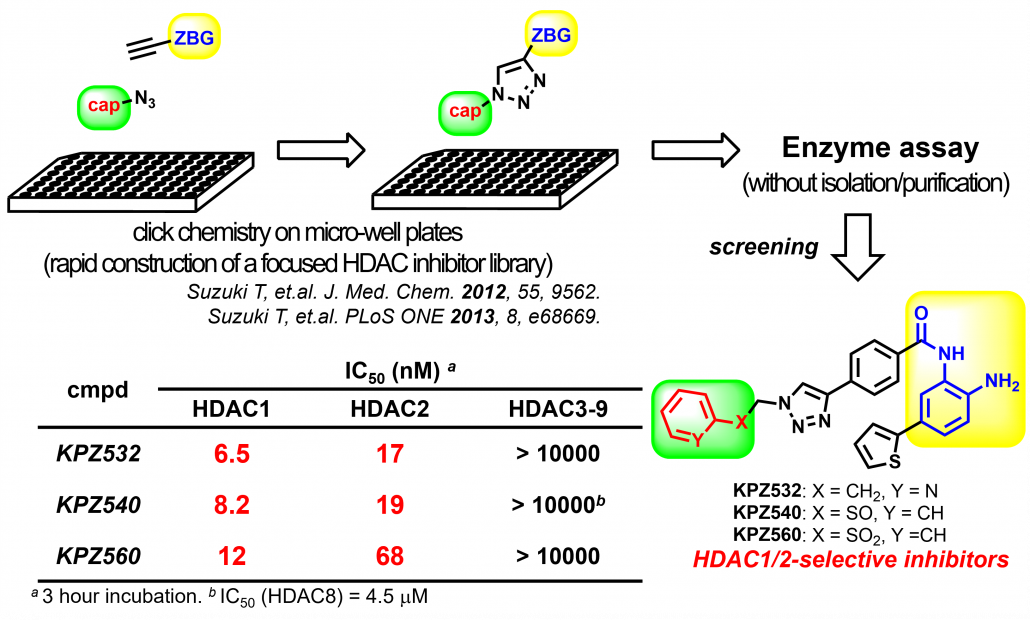
Click chemistry is a useful approach for linking two or more molecular fragments to synthesize new functional molecules. We have used this approach to develop a range of drug candidate molecules. For example, by constructing compound libraries using click chemistry, we have identified inhibitors of histone deacetylases (HDACs). We have also developed an in situ click chemistry strategy for enzymes that contain a metal ion in their active site. In this approach, the metal ion (M^n+) in the enzyme promotes the click reaction directly on the target enzyme. Using this strategy, we have created histone demethylase inhibitors that showed antidepressant-like effects in animal models.
Related Publications
Development of Compounds That Exhibit Pharmacological Activity in an Enzyme Catalysis-Dependent Manner
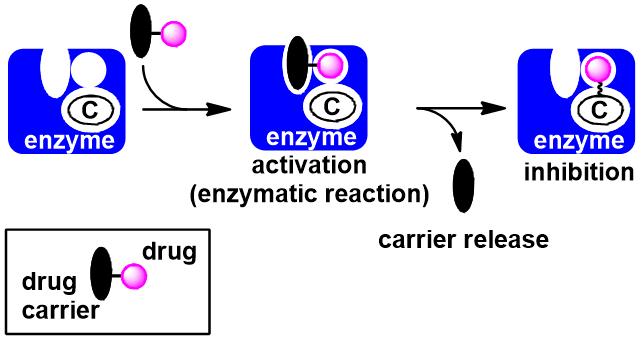
Enzymes catalyze highly specific organic reactions. Our research focuses on the catalytic activity of enzymes that are considered promising drug targets. By taking advantage of these catalytic reactions, we have developed a range of bioactive molecules that function in an activity-dependent manner. Representative examples include NCD38, a small molecule designed to deliver the LSD1 inhibitor PCPA efficiently and selectively to LSD1, and PCPA–drug conjugates (PDCs), a class of drug-delivery compounds that release therapeutic agents selectively in cancer cells.